
Every month, another AI tool adds a new pricing tier. Subscriptions stack up. And if you're an SMB owner, you're probably wondering: at what point does free, open-source AI actually become a real option?
That question got a lot more interesting on June 17, 2026, when Z.ai released GLM-5.2 – a large-scale open-source AI model under an MIT licence. It's available via API, runs inside tools you may already use like Claude Code and Cursor, and handles a 1 million-token context window out of the box.
Whether you're trying to cut software costs or just want to understand what open-source AI can actually do for a non-technical business owner in 2026, this article breaks it down.
What Is GLM-5.2?
GLM-5.2 is the latest model in Z.ai's GLM-5 family, built specifically for what the company calls “long-horizon” tasks – work that unfolds over many steps and requires the model to maintain context and stay on track throughout.
Two things make it different from most AI tools you've encountered:
First, it uses a Mixture-of-Experts architecture. Most AI models activate their full parameter set for every request. GLM-5.2 selectively activates the subset of its parameters most relevant to the task at hand – which is part of why it's competitive on capability without the cost of the largest proprietary models.
Second, it's open-source under an MIT licence. That means you can use it via the Z.ai API, run it inside an existing tool like Claude Code or Cursor, or – if you work with a developer – download the weights from Hugging Face and self-host it on your own infrastructure. No per-seat fees, no usage caps imposed by a vendor, no lock-in.
What Can GLM-5.2 Actually Do?
The headline capability is the context window: 1 million tokens. In practical terms, that's enough to load a lengthy contract, an entire email history with a client, a large data export, or a multi-part research document – and keep all of it in the conversation at once.
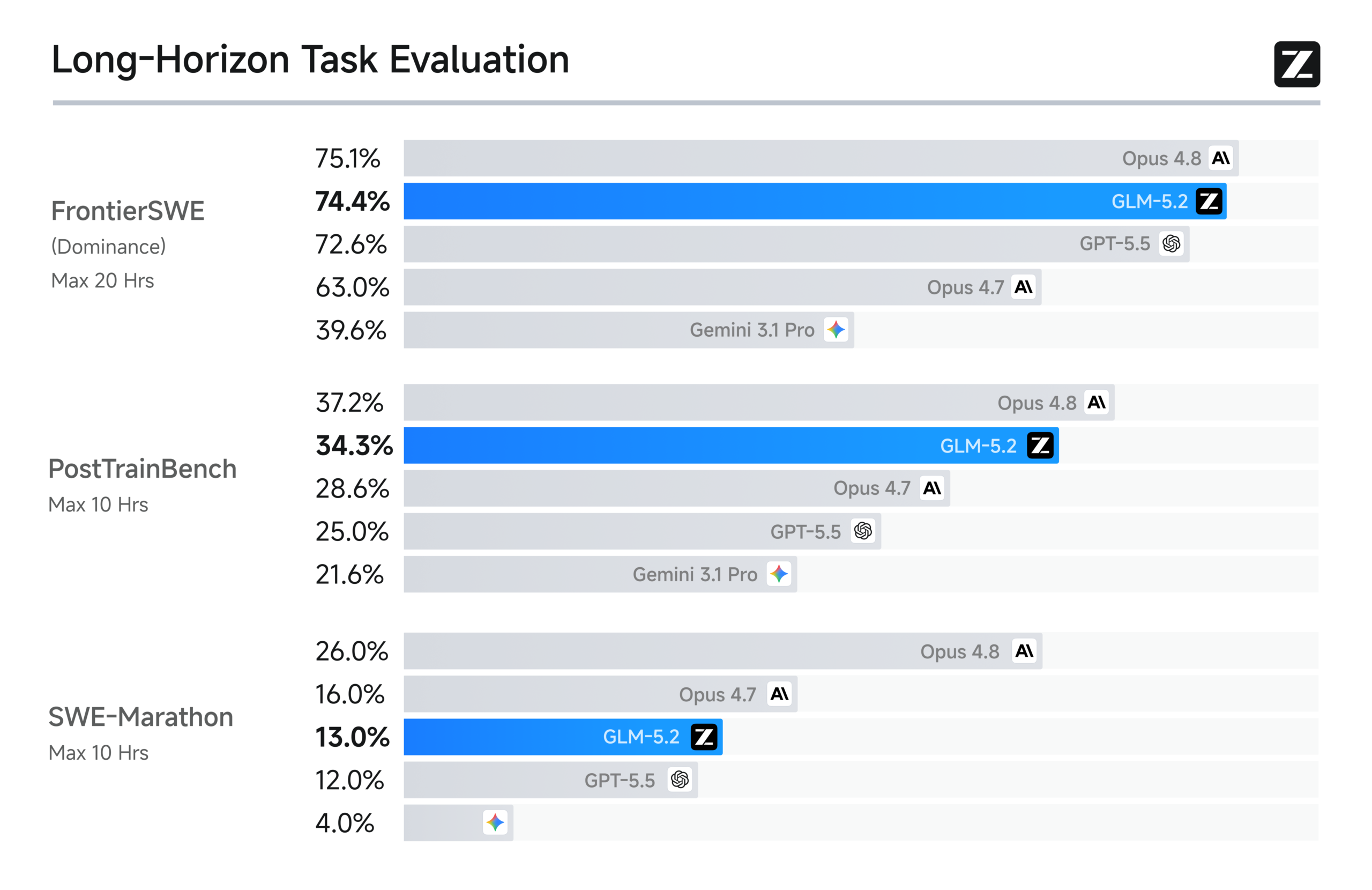
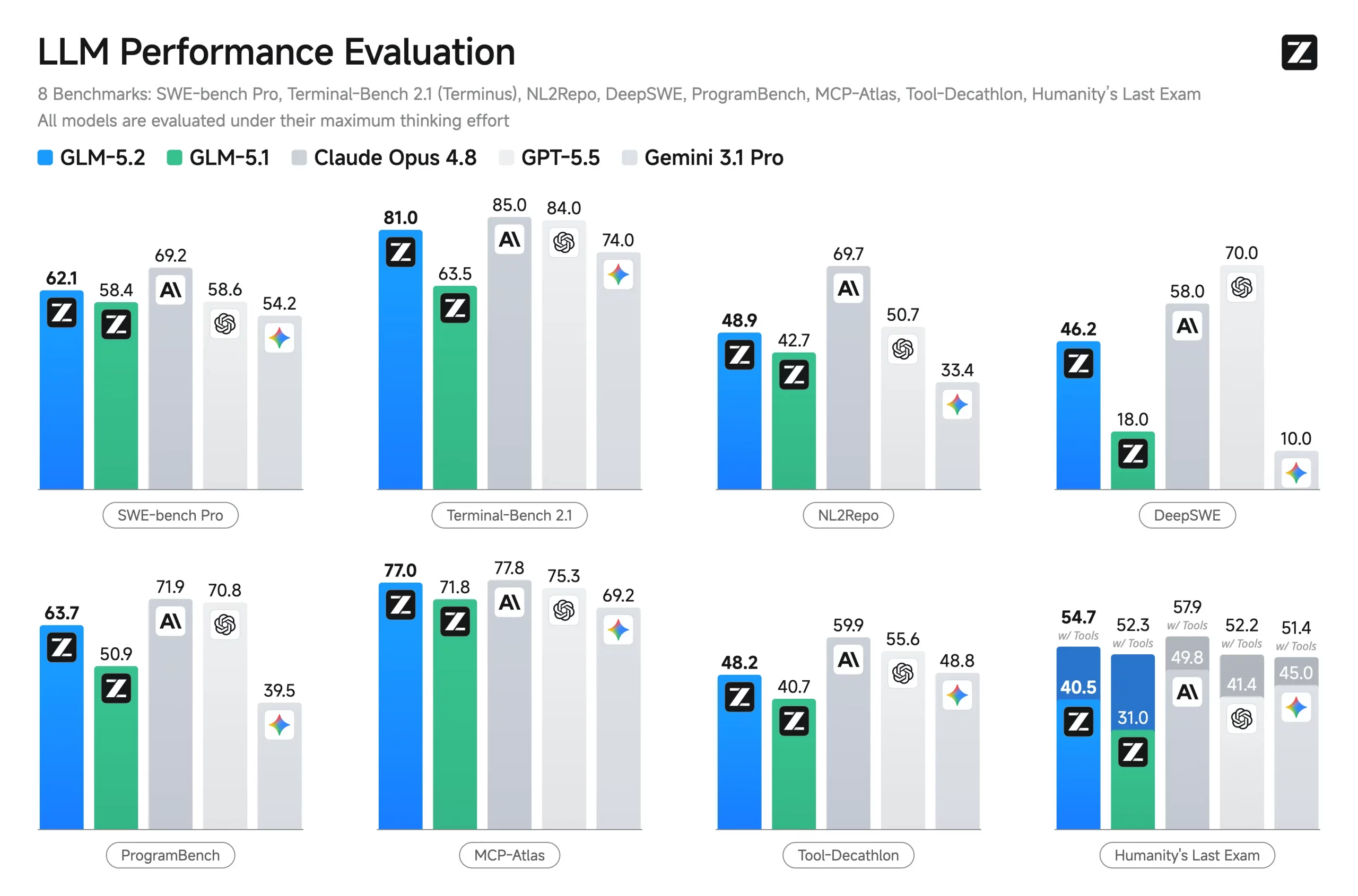
On standard AI benchmarks, GLM-5.2 scores genuinely well. On SWE-bench Pro (which tests autonomous software engineering), it scored 62.1 – up from 58.4 on its predecessor, GLM-5.1. On FrontierSWE, it sits within 1 percentage point of Claude Opus 4.8. On Terminal-Bench 2.1, it reached 81.0. These are coding benchmarks and don't directly map to your day-to-day workflows, but they confirm that the underlying capability is frontier-grade.
For non-technical business owners, the most useful capabilities are:
Long-document analysis. GLM-5.2's 1M context means you can paste in an entire supplier contract, a lengthy report, or a full email thread and ask for summaries, risk flags, or action items – all in one session, without the model losing track of earlier content.
Multi-step task management. The model is designed for agentic work: give it a goal, and it will break it into steps, execute them in sequence, and check its output along the way. This works well for tasks like “review this proposal, identify gaps, and draft a revised version for my approval.”
Integration with developer tools. GLM-5.2 integrates natively with over 20 coding environments, including Claude Code, Cline, and Cursor. If you work with a developer or a technical team member, they can drop GLM-5.2 into their existing workflow without changing their setup.
The model also includes two thinking modes (High and Max) that let you trade response speed against depth of reasoning. For fast, routine tasks, High mode keeps responses quick. For complex analysis where getting it right matters more than speed, Max mode produces more thorough outputs.
How to Access It – and What It Costs
The simplest entry point is the Z.ai API. Current pricing is $1.40 per million input tokens and $4.40 per million output tokens. Cached input (text you send repeatedly across sessions) runs at $0.26 per million tokens – roughly a fifth of the uncached rate.
For context on what that means in practice: a long document analysis session that uses 100,000 input tokens and generates 10,000 output tokens would cost approximately $0.18. You can run hundreds of substantial tasks per month for a few dollars.
If API pricing isn't your preference, the MIT licence means a developer can set up a self-hosted version on your own infrastructure – at which point your only ongoing cost is the compute you run it on.
You can also access GLM-5.2 through the Z.ai chat interface at chat.z.ai, OpenRouter (alongside other models), or Together AI.
Three Business Tasks You Can Test This Week
You don't need a technical background to start. These three tasks work through any chat interface:
1. Contract review and extraction. Copy-paste a supplier agreement, service contract, or terms of service into GLM-5.2. Ask it to summarise the key obligations, payment terms, and any clauses worth discussing with your lawyer. This won't replace legal advice – but it means you understand what you're reading before you pay someone else to explain it.
2. Email thread triage. Paste a long email chain with a client or supplier. Ask GLM-5.2 to identify what has been agreed, what is still outstanding, and draft a follow-up that moves things forward. For complex correspondence, this can compress 20 to 30 minutes of re-reading into a 2-minute review of the model's summary.
3. Report and research summarisation. If you receive industry reports, performance data, or market research, paste the content in and ask for a plain-English summary of the three points most relevant to your business. The 1M context means even long documents fit without needing to be broken up.
When Paid AI Still Makes Sense
Open-source doesn't mean better for everything. If you rely on native integrations – tools that connect to your CRM, your inbox, your project management software – Claude and ChatGPT have more mature connector ecosystems than GLM-5.2 currently does. If you need consistent brand voice or long-term memory across sessions, a well-tuned paid setup with custom instructions will outperform a general API call.
Think of GLM-5.2 as a strong addition for specific tasks – particularly anything that requires reading or analysing large volumes of text – rather than a wholesale replacement for your existing AI stack.
How AppCoders Helps
If you're unsure which AI tools belong in your business and which ones you're overpaying for, that's the question we spend most of our time answering. AppCoders maps your highest-cost workflows, recommends the right combination of paid and open-source tools, and builds the integrations so you don't have to figure it out by trial and error. To find out what that looks like for your business, visit https://appcoders.ae/contact.html#form.
Conclusion
GLM-5.2 is the clearest signal yet that open-source AI has arrived as a viable option for business use. A 1 million-token context window, MIT licensing, API pricing well below the major proprietary models, and native integrations with tools developers already use – it's a meaningful step forward.
It won't replace every paid AI subscription you have. But for document analysis, long-context tasks, and agentic workflows, it's worth testing alongside what you already use.
Start with one task this week. Pick something that takes 20 minutes you'd rather not spend. Paste it into GLM-5.2 via chat.z.ai and see what comes back. That's the fastest way to decide whether it belongs in your workflow.